Explore our network of country and industry based websites to access localized information, product offerings, and business services across our group.
Log in to start sending quotation requests for any product.
Don't have an account? Sign Up Here
Home How DL Methionine Applications Are Transforming Global Animal Feed Markets
Trade Insights | Applications and Buyers | 09 July 2026

Introduction to DL Methionine and Its Industrial Importance
Why DL Methionine Is Essential in Modern Animal Nutrition
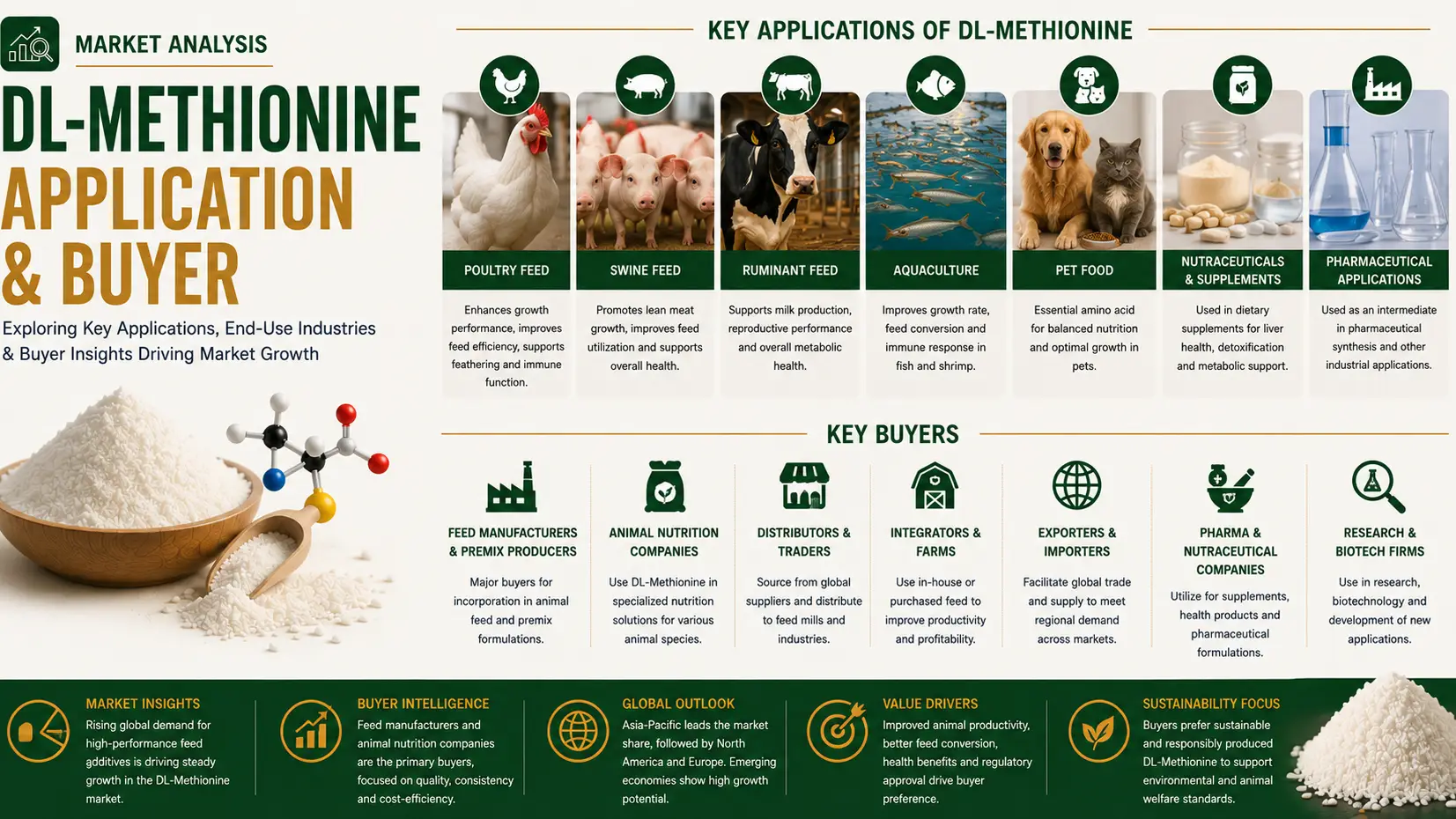
Industrial Applications Across Feed Sectors
Market Trends Driving Global Demand
Buyer Intent and Procurement Considerations
Conclusion
Sources
DL Methionine has become one of the most widely traded amino acid feed additives in the global livestock industry. As an essential amino acid that cannot be synthesized efficiently by poultry, swine, and many aquatic species, it is routinely incorporated into compound feed formulations to improve growth, feed conversion efficiency, and protein utilization. Growing demand for high-quality animal protein has further strengthened the importance of methionine in commercial feed production.
According to the Food and Agriculture Organization (FAO), balanced amino acid nutrition is critical for improving feed efficiency while reducing unnecessary nitrogen emissions from livestock production. This has encouraged feed formulators to optimize dietary amino acid supplementation rather than relying solely on higher crude protein levels.
DL Methionine is produced through industrial chemical synthesis and is recognized for its consistent quality, high purity, and compatibility with large-scale feed manufacturing processes. Compared with increasing crude protein content, supplementing methionine enables nutritionists to formulate more cost-effective diets while maintaining animal performance.
Its commercial significance also extends beyond nutritional performance. Technical guidance published by the European Food Safety Authority (EFSA) highlights methionine supplementation as an important component in precision livestock nutrition, supporting sustainable production systems that improve productivity while reducing environmental impact.
Efficient livestock production increasingly depends on precision nutrition. DL Methionine supports protein synthesis, feather development in poultry, muscle growth in swine, immune function, and overall animal health. Because methionine is often the first limiting amino acid in corn-soybean meal diets, supplementation has become a standard practice across commercial feed operations.
Market assessments published by organizations including OECD-FAO Agricultural Outlook indicate that continued growth in poultry and aquaculture production is expected to sustain long-term demand for amino acid feed additives. This trend is particularly evident in Asia-Pacific, Latin America, and emerging livestock markets where feed efficiency directly influences production costs.
Modern feed manufacturers increasingly use DL Methionine to formulate low-protein diets that maintain animal performance while lowering feed costs. This strategy helps producers reduce nitrogen excretion, supporting stricter environmental regulations and sustainability targets adopted by many livestock industries.
In addition, technical publications from organizations such as the U.S. Soybean Export Council (USSEC) emphasize that balancing essential amino acids—including methionine—allows nutritionists to maximize nutrient utilization, improve feed conversion ratios, and enhance profitability throughout the animal production chain.
DL Methionine plays a vital role across multiple livestock industries because different animal species require carefully balanced amino acid nutrition to achieve optimal growth and production efficiency. As commercial farming continues to intensify worldwide, feed manufacturers increasingly formulate species-specific diets that maximize nutrient utilization while controlling production costs. According to the Food and Agriculture Organization (FAO), precision nutrition is becoming a key strategy for sustainable livestock production.
Growing industrial demand has also encouraged feed producers to adopt standardized amino acid supplementation programs. Instead of increasing crude protein levels, manufacturers can improve animal performance through targeted methionine inclusion, reducing feed waste and improving overall economic returns.
The poultry industry remains the largest consumer of DL Methionine due to its importance in feather development, egg production, growth performance, and feed conversion efficiency. Broiler and layer feed formulations typically include methionine supplementation to meet nutritional requirements throughout different growth stages. Technical guidance from the European Food Safety Authority (EFSA) recognizes methionine as an effective nutritional additive when used according to approved feed regulations.
Swine nutrition also benefits significantly from DL Methionine supplementation, particularly during growth and finishing phases where balanced amino acid profiles improve lean muscle development and feed efficiency. In aquaculture, methionine supports fish growth, protein deposition, and health in species fed plant-based diets. The product is likewise incorporated into specialty feeds for dairy cattle, pets, and other livestock where optimized amino acid nutrition contributes to productivity and animal welfare.
Global demand for DL Methionine continues to increase alongside rising consumption of poultry, pork, seafood, and other animal protein products. According to the OECD-FAO Agricultural Outlook, expanding populations, urbanization, and higher disposable incomes are expected to sustain long-term growth in livestock production, particularly across Asia-Pacific, Latin America, and Africa. These trends directly support continued investment in amino acid feed additives.
Manufacturers are also expanding production capacity to meet growing global demand while improving manufacturing efficiency and product quality. Advances in feed formulation software and precision nutrition technologies further strengthen the role of methionine in modern feed manufacturing.
Environmental sustainability has become another important market driver. Feed producers increasingly formulate low-protein diets supplemented with essential amino acids to reduce nitrogen excretion without sacrificing animal performance. This approach aligns with environmental objectives promoted by international agricultural organizations and regulatory authorities.
Regional demand remains strongest in countries with expanding poultry and aquaculture industries, while mature markets continue focusing on feed optimization and production efficiency. For manufacturers, distributors, and procurement teams, these developments create new sourcing opportunities as reliable suppliers capable of delivering consistent product quality, regulatory compliance, and stable global logistics become increasingly valuable in maintaining resilient supply chains.
Industrial buyers of DL Methionine include feed manufacturers, livestock integrators, animal nutrition companies, premix producers, feed additive distributors, and contract feed mills. These organizations depend on a reliable supply of high-purity methionine to produce nutritionally balanced feed formulations that meet commercial performance targets. According to the Food and Agriculture Organization (FAO), optimizing amino acid supplementation remains an essential component of efficient and sustainable livestock production.
As global feed production continues to expand, procurement teams increasingly seek suppliers capable of ensuring product consistency, regulatory compliance, and dependable international logistics. Purchasing decisions are influenced not only by price but also by supply reliability, technical documentation, and long-term commercial partnerships.
When sourcing DL Methionine, procurement professionals typically assess product purity, manufacturing standards, packaging options, country of origin, quality certifications, and compliance with destination market regulations. Buyers also compare supplier inventory availability, shipment lead times, documentation support, and technical assistance to minimize operational risks and maintain uninterrupted production schedules. Guidance published by the European Food Safety Authority (EFSA) reinforces the importance of using feed additives that meet established safety and quality requirements.
A comprehensive product page on a trusted B2B chemical marketplace helps buyers make informed sourcing decisions by providing detailed product specifications, application guidance, documentation, and supplier information. Platforms such as Tradeasia, Chemtradeasia, and Tradechem Marketplace streamline supplier discovery and international procurement by connecting buyers with qualified manufacturers and distributors capable of supporting long-term sourcing strategies.
DL Methionine has become an indispensable amino acid in modern animal nutrition, supporting efficient feed formulation, improved livestock performance, and sustainable production practices. Its widespread application across poultry, swine, aquaculture, and specialty feed industries reflects its commercial importance in meeting the growing global demand for high-quality animal protein. Industry trends toward precision nutrition, environmental sustainability, and optimized feed efficiency continue to reinforce the product's strategic value for feed manufacturers and livestock producers.
According to market insights from the OECD-FAO Agricultural Outlook, continued expansion of global livestock production is expected to sustain demand for essential amino acid feed additives over the coming years. Manufacturers that prioritize nutritional performance, regulatory compliance, and supply chain resilience are well positioned to capitalize on these opportunities.
For procurement teams, selecting the right DL Methionine supplier involves balancing quality, consistency, logistics, technical support, and commercial reliability. Working with experienced international suppliers helps reduce procurement risks while ensuring uninterrupted access to critical feed ingredients.
Tradeasia International supports global chemical and feed ingredient sourcing by connecting industrial buyers with qualified manufacturers and trusted supply partners. Through comprehensive product information, international distribution capabilities, and responsive customer support, the company helps feed manufacturers, distributors, and procurement professionals source DL Methionine efficiently for diverse industrial applications.
We're committed to your privacy. Tradeasia uses the information you provide to us to contact you about our relevant content, products, and services. For more information, check out our privacy policy.


 English
 Indonesian
 简体字
简体字
 العربية
 Español
 Français
 Português
 日本語
日本語
 한국어
한국어
 Tiếng Việt