Explore our network of country and industry based websites to access localized information, product offerings, and business services across our group.
Log in to start sending quotation requests for any product.
Don't have an account? Sign Up Here
Home DL Methionine Sourcing and Global Feed Market Insights
Trade Insights | Applications and Buyers | 23 June 2026

DL Methionine Market Overview and Demand Drivers
Industrial Production and Feed-Grade Specifications
Key Applications in Animal Nutrition
Global Supply Chain and Sourcing Dynamics
Quality Standards, Pricing Factors, and Procurement Considerations
Future Outlook and Sustainability Trends in Amino Acid Feed Additives
Buyer Intent and Procurement Decision Factors
Conclusion and Strategic Market Perspective
Sources
DL Methionine is a sulfur-containing essential amino acid widely used in animal nutrition to balance protein efficiency in livestock feed formulations. According to the Food and Agriculture Organization (FAO), global meat consumption continues to rise, directly increasing demand for optimized feed additives such as methionine.
The compound plays a crucial role in poultry and swine diets, where it supports growth performance and feed conversion efficiency. Market demand is strongly linked to intensive animal farming systems, particularly in Asia-Pacific and Latin America.
Feed manufacturers prioritize DL Methionine due to its cost-effectiveness compared to natural protein sources, making it a standard ingredient in commercial feed formulations. Its adoption continues to expand alongside industrial livestock production growth.
DL Methionine is often used as a limiting amino acid supplement in corn-soybean based feed systems. Industry research published by the National Research Council (NRC) highlights its importance in achieving balanced amino acid profiles for optimal animal growth.
Feed formulation technologies increasingly rely on synthetic amino acids to reduce crude protein levels while maintaining productivity. This shift is driven by both economic and environmental efficiency considerations.
The result is a growing dependency on methionine imports in regions with large-scale livestock operations but limited domestic production capacity.
DL Methionine is primarily produced through chemical synthesis using petrochemical-derived intermediates, ensuring large-scale availability and consistent purity. According to technical data from OECD chemical safety assessments, industrial production is tightly controlled to meet feed-grade requirements.
Manufacturers typically produce racemic mixtures (D- and L-isomers), which are biologically converted in animals to usable L-methionine. This enhances its efficiency in feed applications.
Production hubs are concentrated in China, Europe, and the United States, with global distribution networks supplying feed mills worldwide.
Feed-grade DL Methionine must comply with stringent purity and safety standards set by regulatory authorities such as the European Food Safety Authority (EFSA). These standards ensure safety in livestock consumption and downstream food production.
Quality specifications typically include high assay content, low heavy metal residues, and consistent particle size for feed blending efficiency.
Compliance with these standards is a key procurement factor for buyers evaluating long-term supplier partnerships.
DL Methionine is extensively used in poultry feed to support feather development, egg production, and growth performance. Industry data from the United States Department of Agriculture (USDA) indicates that poultry feed accounts for the largest share of global amino acid consumption.
It helps reduce reliance on high-protein raw materials while maintaining nutritional balance in broiler and layer diets.
This makes it indispensable for commercial poultry operations seeking cost-efficient feed optimization.
In swine nutrition, DL Methionine supports muscle development and metabolic efficiency, improving feed conversion ratios. Research from animal nutrition institutes shows measurable performance gains when methionine balance is optimized.
In aquaculture, it contributes to fish growth and protein synthesis, particularly in intensive farming systems.
Its versatility across multiple livestock categories reinforces its status as a core feed additive globally.
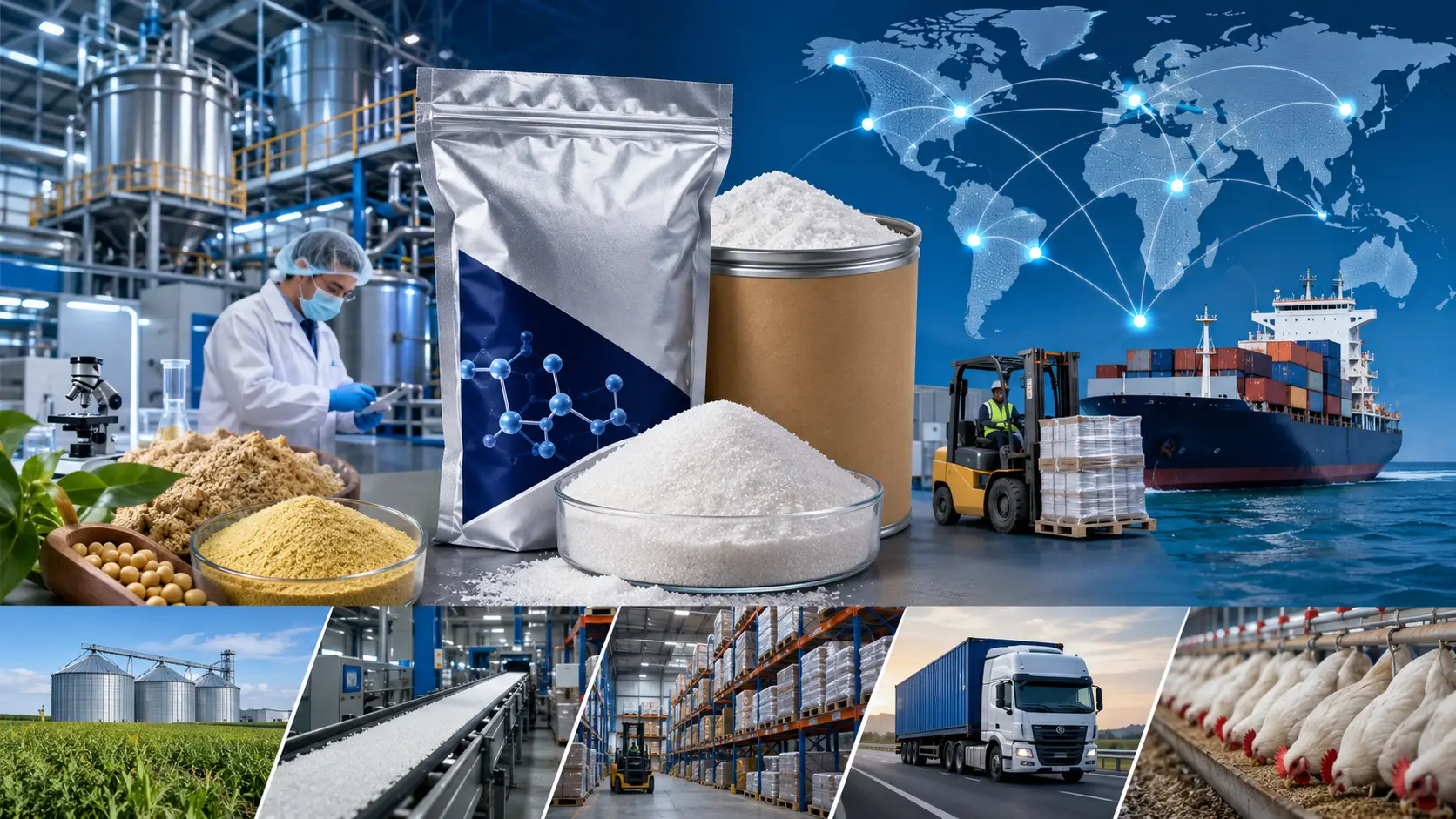
DL Methionine supply chains are highly globalized, with production concentrated in a few major chemical manufacturing regions. Market analysis from Grand View Research highlights increasing cross-border trade due to rising feed demand in emerging economies.
Distributors and chemical trading platforms play a critical role in connecting manufacturers with feed mills and livestock integrators.
This structure makes supply continuity and logistics efficiency essential procurement priorities.
Pricing of DL Methionine is influenced by raw material costs, energy prices, and production capacity utilization. Industry reports from OECD chemical markets indicate that petrochemical fluctuations directly affect amino acid pricing trends.
Buyers often engage in long-term contracts to stabilize procurement costs and ensure consistent supply.
This makes strategic sourcing relationships critical in maintaining feed production stability.
Feed additives like DL Methionine must comply with international feed safety regulations to ensure animal and human health protection. EFSA and Codex Alimentarius provide key guidelines for acceptable usage levels and purity standards.
These regulations influence buyer selection criteria and supplier qualification processes in global trade.
Certification and traceability are increasingly important in procurement decisions across large feed manufacturers.
Buyers evaluate DL Methionine suppliers based on consistency, pricing stability, logistics capability, and compliance documentation. Procurement teams prioritize suppliers with proven global distribution networks.
Feed manufacturers often integrate multiple sourcing channels to reduce risk and ensure uninterrupted production.
This creates strong demand for reliable B2B chemical marketplaces and trading platforms.
The global feed industry is shifting toward sustainable protein optimization strategies, where amino acids like DL Methionine reduce environmental impact. FAO studies emphasize reducing nitrogen waste through balanced amino acid diets.
This positions methionine as a key enabler of environmentally responsible livestock production.
Sustainability goals are driving increased adoption across both developed and emerging markets.
Future developments include more efficient fermentation-based production methods and improved supply chain transparency. Industry research indicates growing investment in greener chemical production pathways.
Digital procurement systems are also transforming how buyers source feed additives globally.
These innovations are expected to stabilize supply while improving environmental performance.
DL Methionine is primarily purchased by feed mill operators, livestock integrators, aquaculture producers, and agricultural distributors. These buyers focus on feed efficiency, cost optimization, and regulatory compliance when selecting suppliers.
Procurement teams evaluate product consistency, supply reliability, certification standards, and global logistics capability before purchase decisions. Price competitiveness is important but secondary to quality assurance in large-scale operations.
Buyers also compare suppliers based on long-term availability and technical support for feed formulation optimization. This makes DL Methionine listings on B2B marketplaces critical for informed sourcing decisions and global trade connectivity.
DL Methionine remains a foundational ingredient in modern animal nutrition systems, enabling efficient protein utilization across poultry, swine, and aquaculture industries. Its demand continues to grow alongside global meat consumption trends.
The compound’s strategic importance in feed formulation ensures stable long-term market relevance. Procurement decisions are increasingly influenced by supply chain resilience and regulatory compliance.
For B2B buyers and suppliers, DL Methionine represents both a high-demand commodity and a critical component of global food production efficiency.
https://www.fao.org
https://www.efsa.europa.eu
https://www.oecd.org
We're committed to your privacy. Tradeasia uses the information you provide to us to contact you about our relevant content, products, and services. For more information, check out our privacy policy.


 English
 Indonesian
 简体字
简体字
 العربية
 Español
 Français
 Português
 日本語
日本語
 한국어
한국어
 Tiếng Việt