Explore our network of country and industry based websites to access localized information, product offerings, and business services across our group.
Log in to start sending quotation requests for any product.
Don't have an account? Sign Up Here
Home Global Deoiled Rice Bran: Supply Chain Trends and Sourcing Insights
Trade Insights | Supply Chain | 09 July 2026

Introduction to the Deoiled Rice Bran Market
Understanding the Global Deoiled Rice Bran Supply Chain
Major Producing Regions and Export Dynamics
Market Drivers Supporting Global Demand
Buyer Intent: What Procurement Teams Look For
Future Market Outlook for Deoiled Rice Bran
Conclusion
Sources
Deoiled rice bran has become an increasingly important feed ingredient as livestock producers seek economical and nutritionally balanced alternatives to conventional feed materials. Derived from rice bran after oil extraction, it contains valuable protein, dietary fiber, minerals, and residual energy, making it widely used in cattle, poultry, aquaculture, and swine feed formulations. Growing rice production across Asia has also strengthened the availability of deoiled rice bran for international trade.
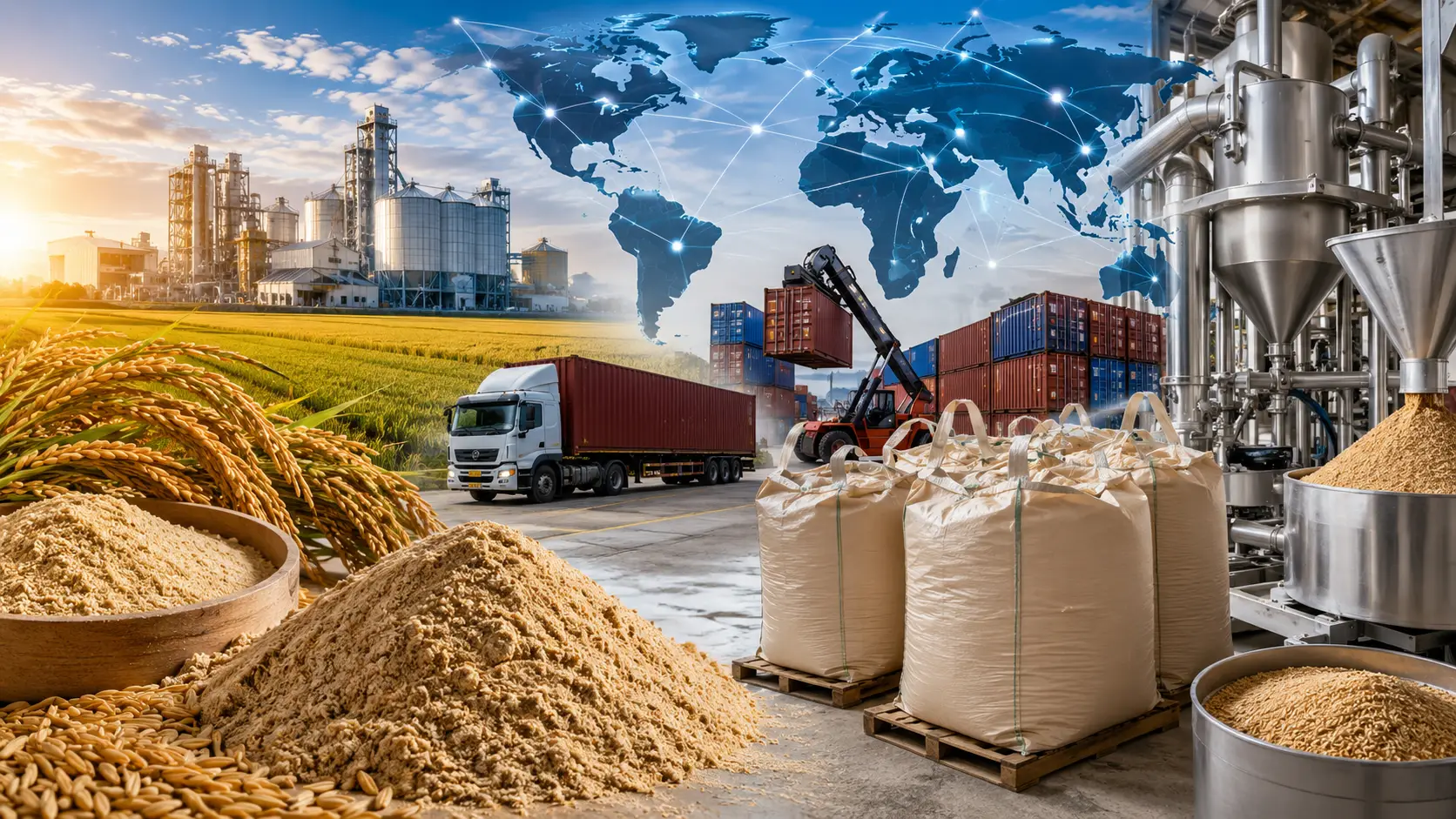
The supply chain begins with rice milling, where bran is separated from polished rice. Fresh rice bran is stabilized and processed to extract rice bran oil through solvent extraction or mechanical methods. The remaining solid material becomes deoiled rice bran, which is then dried, screened, tested, and packaged for commercial distribution.
According to the Food and Agriculture Organization (FAO), Asia accounts for over 85% of global rice production, making countries such as India, China, Vietnam, Thailand, and Bangladesh the primary production hubs for rice bran-derived products. The abundance of raw material gives these regions a competitive advantage in global feed ingredient exports.
Quality consistency depends heavily on moisture control, extraction efficiency, storage conditions, and transportation logistics. Suppliers with integrated milling and extraction facilities are often better positioned to deliver uniform specifications and maintain year-round supply reliability for international buyers.
As global feed manufacturers seek dependable ingredient sourcing, vertically integrated producers and experienced trading companies continue to play an important role in connecting agricultural processing facilities with livestock feed manufacturers worldwide.
India remains one of the world's largest producers and exporters of deoiled rice bran due to its extensive rice cultivation and well-developed rice bran oil industry. Vietnam and Thailand also contribute significantly, supplying regional feed markets and export destinations across Asia and the Middle East.
According to the United States Department of Agriculture (USDA), expanding feed demand across developing economies continues to support international trade in alternative feed ingredients. Deoiled rice bran is increasingly selected because it offers favorable nutritional value while helping reduce overall feed formulation costs.
Export competitiveness is influenced by rice harvest volumes, freight rates, domestic feed demand, government export policies, and seasonal availability. Weather conditions affecting rice production can also influence raw material availability and pricing throughout the supply chain.
For international procurement teams, supplier evaluation increasingly extends beyond pricing to include production capacity, traceability, export documentation, packaging flexibility, and compliance with destination-country feed regulations.
The global livestock industry continues to expand alongside rising consumption of meat, dairy products, and aquaculture products. Feed manufacturers are actively diversifying raw material sourcing to reduce dependence on more volatile commodities such as soybean meal and corn.
Industry analysis from organizations such as the International Grains Council (IGC) indicates that growing feed demand in Asia, Africa, and the Middle East is encouraging greater utilization of agricultural by-products with proven nutritional value. Deoiled rice bran fits well within this trend because it combines competitive pricing with broad formulation flexibility.
Sustainability initiatives are also increasing interest in rice processing by-products. By converting what was traditionally considered a milling by-product into a valuable feed ingredient, manufacturers contribute to circular economy practices while improving resource efficiency throughout the agricultural supply chain.
As procurement strategies become more focused on long-term supply security, buyers increasingly favor suppliers capable of providing consistent product quality, stable logistics, technical documentation, and reliable export support across multiple shipment volumes.
As the global feed industry expands, procurement professionals are placing greater emphasis on supplier reliability rather than simply selecting the lowest-priced product. Deoiled rice bran is commonly purchased by animal feed manufacturers, feed premix producers, dairy nutrition companies, livestock integrators, aquaculture feed producers, agricultural distributors, and international commodity traders seeking a consistent and cost-effective feed ingredient.
According to technical guidance published by the Food and Agriculture Organization (FAO), the nutritional quality of feed ingredients directly influences livestock productivity and feed conversion efficiency. Consequently, buyers evaluate protein content, crude fiber, residual oil, ash, moisture level, digestibility, and product consistency before finalizing procurement decisions.
Supplier capability is another major purchasing factor. Industrial buyers typically compare manufacturing capacity, export experience, quality management systems, packaging options, logistics support, and documentation such as Certificates of Analysis (COA), Material Safety Data Sheets (MSDS), phytosanitary certificates where applicable, and country-specific regulatory compliance.
For many procurement teams, an informative product page simplifies supplier evaluation by presenting detailed technical specifications, application guidance, quality assurance information, and sourcing support. B2B marketplaces such as Tradeasia, Chemtradeasia, and Tradechem Marketplace help buyers compare sourcing options while reducing the time required to identify qualified international suppliers.
Global demand for affordable and sustainable feed ingredients is expected to remain strong over the coming years. Population growth, increasing protein consumption, and the expansion of commercial livestock and aquaculture industries continue to support higher feed production worldwide. These trends are expected to reinforce demand for deoiled rice bran as an economical complementary feed ingredient.
Market research published by organizations such as the Organisation for Economic Co-operation and Development (OECD) and the FAO projects continued growth in agricultural production and animal protein consumption, particularly across Asia, Africa, and emerging economies. As rice production expands, the availability of rice bran for further processing is also expected to increase, supporting long-term supply.
Future competitiveness will depend on processing efficiency, quality consistency, sustainable production practices, and resilient international logistics. Digital procurement platforms and improved supply chain transparency are also helping buyers identify qualified suppliers with greater confidence while improving transaction efficiency.
For businesses seeking dependable sourcing solutions, Tradeasia International, Chemtradeasia, and Tradechem Marketplace connect global buyers with established manufacturers and exporters of industrial chemicals and feed ingredients. Their international sourcing network, quality-focused supplier partnerships, and export capabilities enable procurement teams to secure reliable supplies of deoiled rice bran for diverse industrial applications.
We're committed to your privacy. Tradeasia uses the information you provide to us to contact you about our relevant content, products, and services. For more information, check out our privacy policy.


 English
 Indonesian
 简体字
简体字
 العربية
 Español
 Français
 Português
 日本語
日本語
 한국어
한국어
 Tiếng Việt