Explore our network of country and industry based websites to access localized information, product offerings, and business services across our group.
Log in to start sending quotation requests for any product.
Don't have an account? Sign Up Here
Home DL Methionine Global Supply Chain & Procurement Insights
Trade Insights | Supply Chain | 23 June 2026

Introduction to DL Methionine in Animal Nutrition
Global Demand Drivers and Market Expansion
Industrial Applications Across Feed and Nutrition Sectors
Production Pathways and Supply Chain Structure
Pricing Dynamics and Procurement Considerations
Regional Trade Flow and Future Market Outlook
Buyer Intent and Sourcing Decision Factors
Sources
DL methionine is a synthetic, feed-grade essential amino acid widely used to balance protein formulations in livestock and poultry diets. It plays a critical role in improving feed efficiency and supporting optimal animal growth performance. According to the Food and Agriculture Organization (FAO), amino acid supplementation is a key driver in modern feed optimization strategies aimed at improving global protein production efficiency.
DL methionine is primarily used to correct methionine deficiencies in plant-based feed ingredients such as soybean meal and corn gluten. It ensures that livestock receive a complete amino acid profile necessary for muscle development and metabolic health. Industry studies published by the OECD-FAO Agricultural Outlook highlight its importance in sustainable intensification of livestock production systems.
From a formulation perspective, DL methionine allows feed manufacturers to reduce reliance on expensive protein sources while maintaining nutritional adequacy. This contributes to cost optimization in commercial feed production. It is especially critical in poultry diets where methionine is often the first limiting amino acid.
Feed producers rely on DL methionine not only for performance enhancement but also for consistency in large-scale production. Its standardized chemical structure ensures predictable digestibility and bioavailability across feed batches.
The global demand for DL methionine is strongly driven by the expansion of industrial livestock farming and increasing protein consumption worldwide. Market research published by Grand View Research indicates sustained growth in amino acid feed additives due to rising poultry and swine production.
DL methionine demand is closely tied to the poultry sector, which accounts for a significant share of global feed consumption. As poultry production intensifies, feed formulations increasingly depend on synthetic amino acids to maintain efficiency and cost control.
Swine and aquaculture industries also contribute to rising demand as they adopt precision nutrition strategies. These industries require balanced amino acid profiles to improve feed conversion ratios and reduce environmental nitrogen waste.
The expansion of integrated farming systems in Asia-Pacific and Latin America further strengthens global consumption patterns. These regions are key growth hubs for feed-grade amino acids due to industrialization of agriculture.
DL methionine is primarily used in animal nutrition but also finds applications in pet food and specialty feed formulations. Its functional role is to enhance protein synthesis and support metabolic efficiency in animals.
In poultry feed, DL methionine is essential for egg production, feather development, and growth performance. It is one of the most critical amino acids in broiler and layer diets, ensuring optimal feed conversion ratios.
In swine nutrition, it supports muscle growth and improves nitrogen utilization efficiency. Aquaculture feed formulations also rely on methionine supplementation to enhance fish growth and protein retention.
These applications are supported by technical evaluations from the European Food Safety Authority (EFSA), which recognizes methionine as a safe and essential feed additive under regulated usage levels.
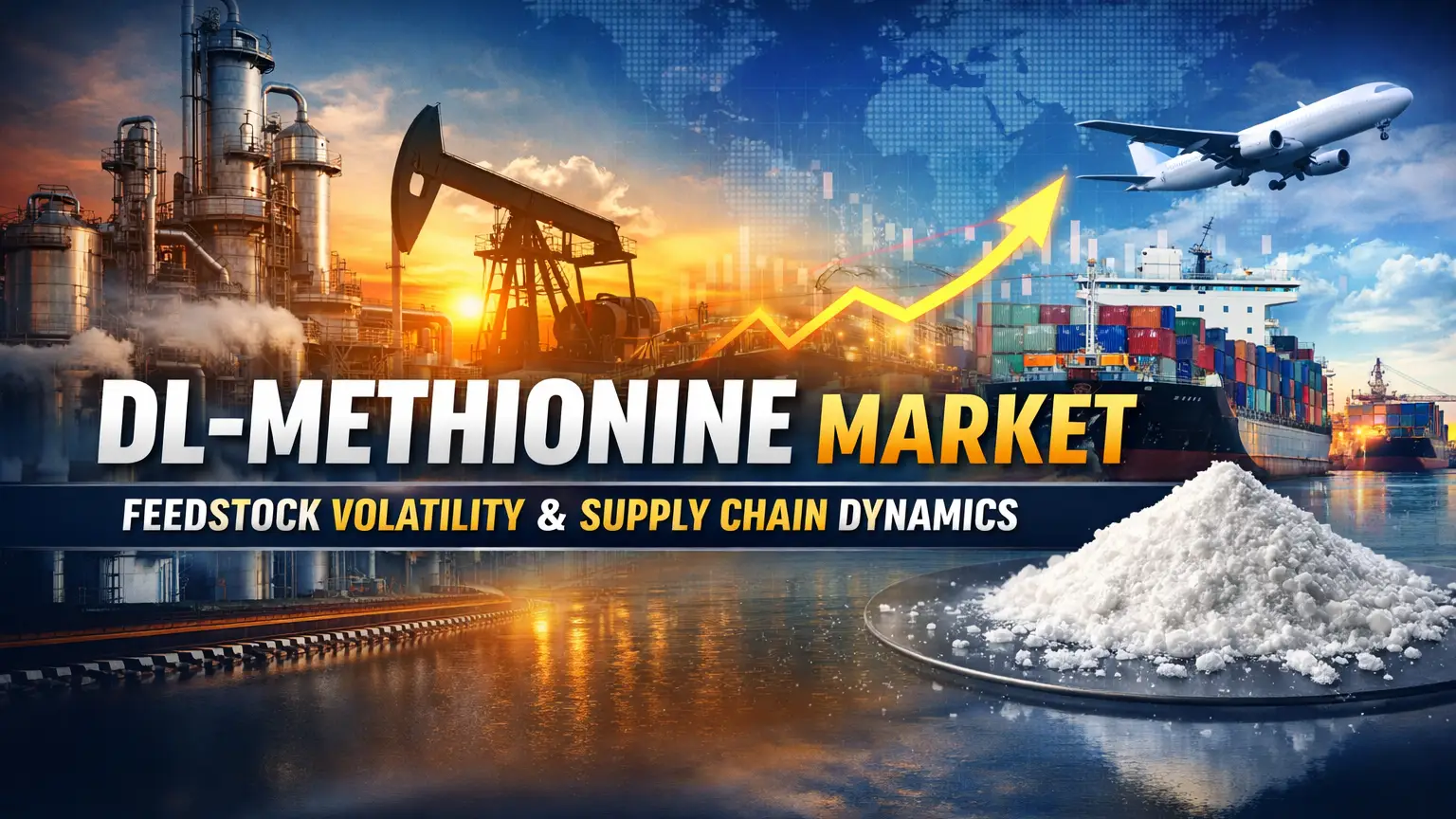
DL methionine production is highly industrialized and concentrated among a limited number of global manufacturers. The supply chain typically involves petrochemical-based synthesis routes followed by purification and crystallization processes.
The production process begins with chemical synthesis using precursors derived from petrochemical feedstocks. This ensures consistent quality and scalability for global distribution.
Once produced, DL methionine is distributed through a complex supply chain involving chemical traders, distributors, and feed ingredient suppliers. Logistics efficiency plays a critical role in maintaining price stability and availability.
According to industry insights from ICIS Chemical Market Analytics, supply chain concentration makes DL methionine sensitive to production disruptions and global shipping constraints.
DL methionine pricing is influenced by raw material costs, production capacity, energy prices, and global freight conditions. Buyers must evaluate both short-term volatility and long-term contract structures when sourcing.
Procurement teams in feed manufacturing industries prioritize supply reliability, consistent quality, and competitive pricing. Long-term agreements are often preferred to mitigate exposure to market fluctuations.
Currency exchange rates and regional trade policies also impact import costs, especially in emerging markets. Buyers often diversify suppliers to reduce dependency risk and ensure supply continuity.
Market analysis from the World Bank commodity outlook indicates that feed additive pricing remains closely linked to energy markets and petrochemical cycles.
Asia-Pacific dominates global DL methionine consumption due to its large-scale poultry and aquaculture industries. China, India, and Southeast Asia represent key import-driven markets.
Europe maintains strong production capacity, while exporting to high-demand regions in Asia and Latin America. Trade flows are shaped by regulatory standards and feed safety compliance requirements.
Latin America is emerging as a significant growth region due to expanding livestock production and export-oriented agriculture. This is increasing demand for imported amino acid feed additives.
Future outlook suggests continued demand growth driven by protein consumption trends and efficiency-focused feed formulation strategies, as highlighted in global agricultural projections by FAO and OECD.
Buyers of DL methionine typically include feed manufacturers, integrators, livestock producers, and chemical distributors. Their procurement decisions are driven by cost efficiency, supply stability, and product consistency.
Procurement teams evaluate supplier reliability, documentation compliance, and logistics performance before finalizing contracts. Technical specifications such as purity and feed-grade certification are also critical.
The product page and marketplace listing support sourcing decisions by providing standardized specifications, bulk availability, and global supplier access. This helps buyers reduce sourcing time and improve procurement efficiency.
Ultimately, DL methionine purchasing is a strategic decision tied to feed performance optimization and long-term supply chain resilience.
https://www.fao.org
https://www.grandviewresearch.com
We're committed to your privacy. Tradeasia uses the information you provide to us to contact you about our relevant content, products, and services. For more information, check out our privacy policy.


 English
 Indonesian
 简体字
简体字
 العربية
 Español
 Français
 Português
 日本語
日本語
 한국어
한국어
 Tiếng Việt