Explore our network of country and industry based websites to access localized information, product offerings, and business services across our group.
Log in to start sending quotation requests for any product.
Don't have an account? Sign Up Here
Home Manganese Carbonate Supply Chain and Global Sourcing Guide for B2B Buyers
Trade Insights | Supply Chain | 30 June 2026

Understanding Manganese Carbonate in Industrial Trade
Major Industrial Applications of Manganese Carbonate
Market Trends Influencing Global Demand
Buyer Intent and Procurement Considerations
Manganese Carbonate Supply Chain and Sourcing Landscape
Future Outlook for Global Buyers and Suppliers
Sources
Manganese carbonate is an inorganic compound widely used as a source of manganese across multiple industrial sectors. It typically appears as a pinkish or light brown powder and functions as an intermediate material in various chemical manufacturing processes.
Industrial demand for manganese compounds continues to expand because manganese remains an essential element in agriculture, feed production, and specialty manufacturing sectors. Manganese carbonate has become increasingly important because it provides a reliable manganese source with broad compatibility.
Technical information from scientific references published by the U.S. National Center for Biotechnology Information indicates that manganese compounds play important roles in biological and industrial processes due to their chemical properties and trace mineral functionality.
Its physical and chemical characteristics make manganese carbonate suitable for formulation processes requiring controlled manganese content. Manufacturers and procurement teams frequently consider purity, consistency, and downstream processing compatibility during sourcing activities.
Manganese carbonate supports several downstream industries because manganese serves as an essential micronutrient and process material. Commercial demand is driven by industries requiring mineral supplementation and chemical manufacturing inputs.
Agricultural applications represent one of the major consumption segments because manganese deficiency can affect crop productivity and plant development. Fertilizer manufacturers incorporate manganese-based compounds into nutrient formulations.
According to technical information published by the Food and Agriculture Organization and agricultural research institutions, manganese contributes to enzyme activation and plant metabolic functions, supporting demand for micronutrient products.
Feed manufacturers also utilize manganese compounds in animal nutrition formulations. In addition, chemical processors use manganese carbonate as a precursor material in producing specialty manganese compounds used in pigments and industrial formulations.
Global manganese carbonate demand is evolving due to broader industrial trends affecting chemicals and raw material sourcing. Increasing attention toward agricultural efficiency and advanced industrial manufacturing is influencing consumption patterns.
Market activity has also shifted because procurement strategies increasingly prioritize supply reliability and regional diversification. Manufacturers are evaluating long-term sourcing relationships to reduce operational risks.
Market analysis published by industrial research organizations suggests growing interest in battery-related materials and specialty manganese products that support advanced technologies and manufacturing processes.
Industrial buyers increasingly seek suppliers capable of maintaining quality standards and supporting scalable procurement volumes. This trend contributes to stronger demand for globally connected chemical marketplaces and sourcing platforms.
Manganese carbonate buyers usually include fertilizer manufacturers, feed additive producers, chemical processors, distributors, and industrial manufacturers seeking manganese-based raw materials.
Procurement teams evaluate multiple factors before making purchasing decisions because product consistency directly influences downstream performance and manufacturing efficiency.
According to procurement practices outlined by chemical industry associations, buyers typically assess purity specifications, regulatory documentation, packaging standards, supply capacity, and logistics performance during supplier selection processes.
Buyers compare suppliers because differences in quality assurance systems, geographic sourcing capabilities, lead times, and technical support may significantly affect total procurement costs. Product pages on B2B marketplaces support purchasing decisions by presenting technical data and commercial information efficiently.
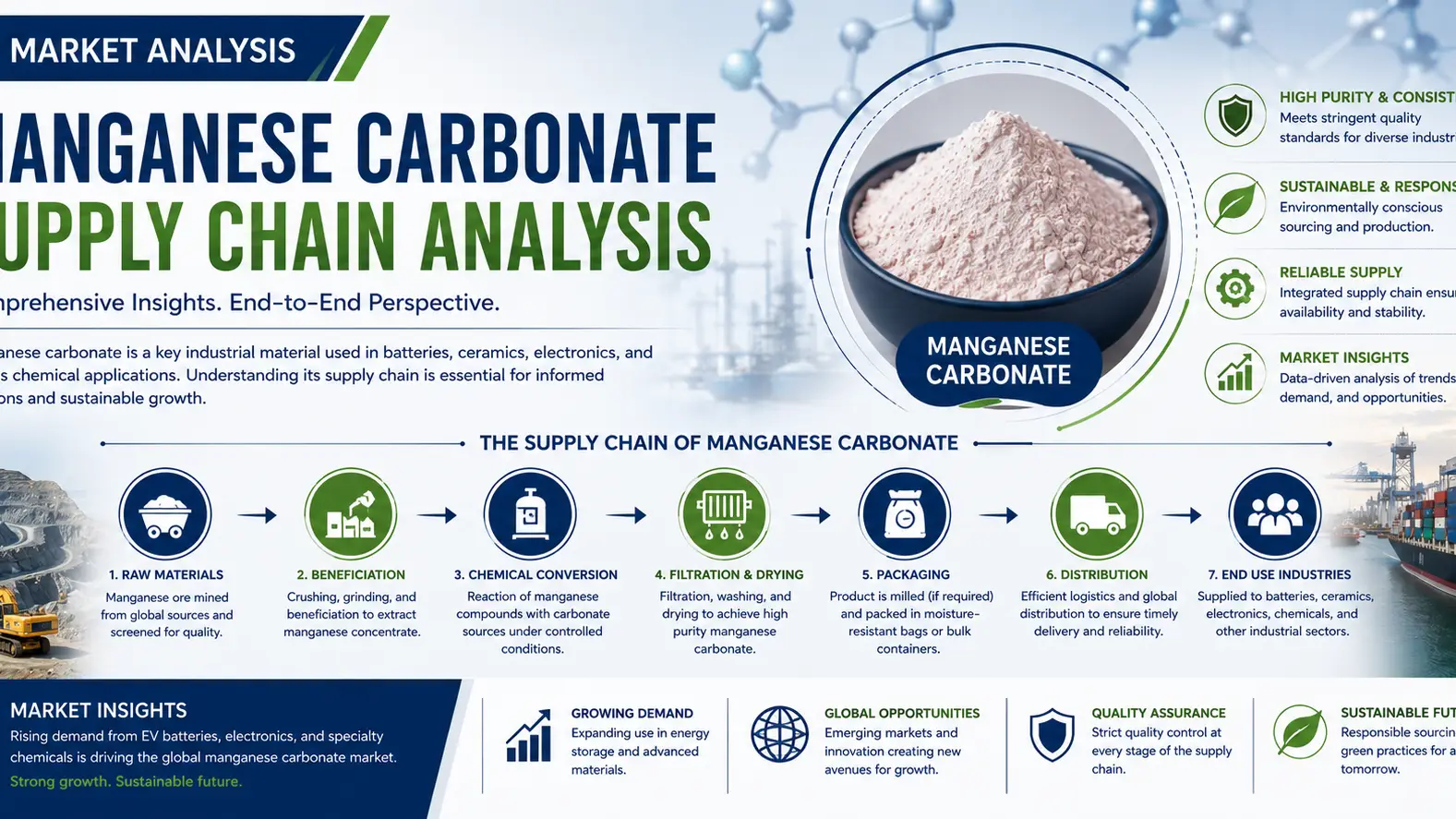
The manganese carbonate supply chain begins with manganese ore extraction and mineral processing activities before moving through refining and manufacturing stages. Production networks often involve multiple geographic regions and processing facilities.
Supply chain resilience has become a major focus area for chemical buyers due to transportation costs, geopolitical influences, and fluctuations in raw material availability.
Based on industry reporting from chemical trade publications and manufacturing organizations, companies increasingly diversify sourcing strategies to reduce supply disruptions and improve procurement flexibility.
B2B chemical marketplaces create centralized environments where procurement teams can identify suppliers, compare offerings, and evaluate commercial opportunities across regional markets. This approach supports more efficient sourcing workflows.
Manganese carbonate demand is expected to remain supported by industrial expansion and continued investment in agricultural productivity. Specialty chemical applications may also contribute to future growth opportunities.
Manufacturers and distributors continue to strengthen supply chain capabilities because purchasing decisions increasingly involve both technical requirements and strategic sourcing considerations.
According to industrial market assessments and materials research studies, demand for manganese-related products may benefit from evolving manufacturing technologies and industrial modernization initiatives.
For suppliers and procurement teams, market visibility and sourcing efficiency are becoming increasingly important competitive factors. Companies capable of providing reliable supply networks and technical transparency are positioned to support long-term business growth.
National Center for Biotechnology Information (NCBI)
We're committed to your privacy. Tradeasia uses the information you provide to us to contact you about our relevant content, products, and services. For more information, check out our privacy policy.


 English
 Indonesian
 简体字
简体字
 العربية
 Español
 Français
 Português
 日本語
日本語
 한국어
한국어
 Tiếng Việt