Explore our network of country and industry based websites to access localized information, product offerings, and business services across our group.
Log in to start sending quotation requests for any product.
Don't have an account? Sign Up Here
Home Vitamin B12 Sourcing: Applications, Buyers and Supply Considerations
Trade Insights | Supply Chain | 21 August 2026
What Is Vitamin B12 and Why Does It Matter to B2B Buyers?
Industrial Applications of Vitamin B12
Vitamin B12 Demand and Emerging Application Trends
What Buyers Should Evaluate When Sourcing Vitamin B12
Buyer Intent and Supplier Comparison
Commercial Sourcing Opportunities for Vitamin B12
How to Approach Vitamin B12 Procurement Through a B2B Marketplace
Conclusion: Building a Reliable Vitamin B12 Supply Strategy
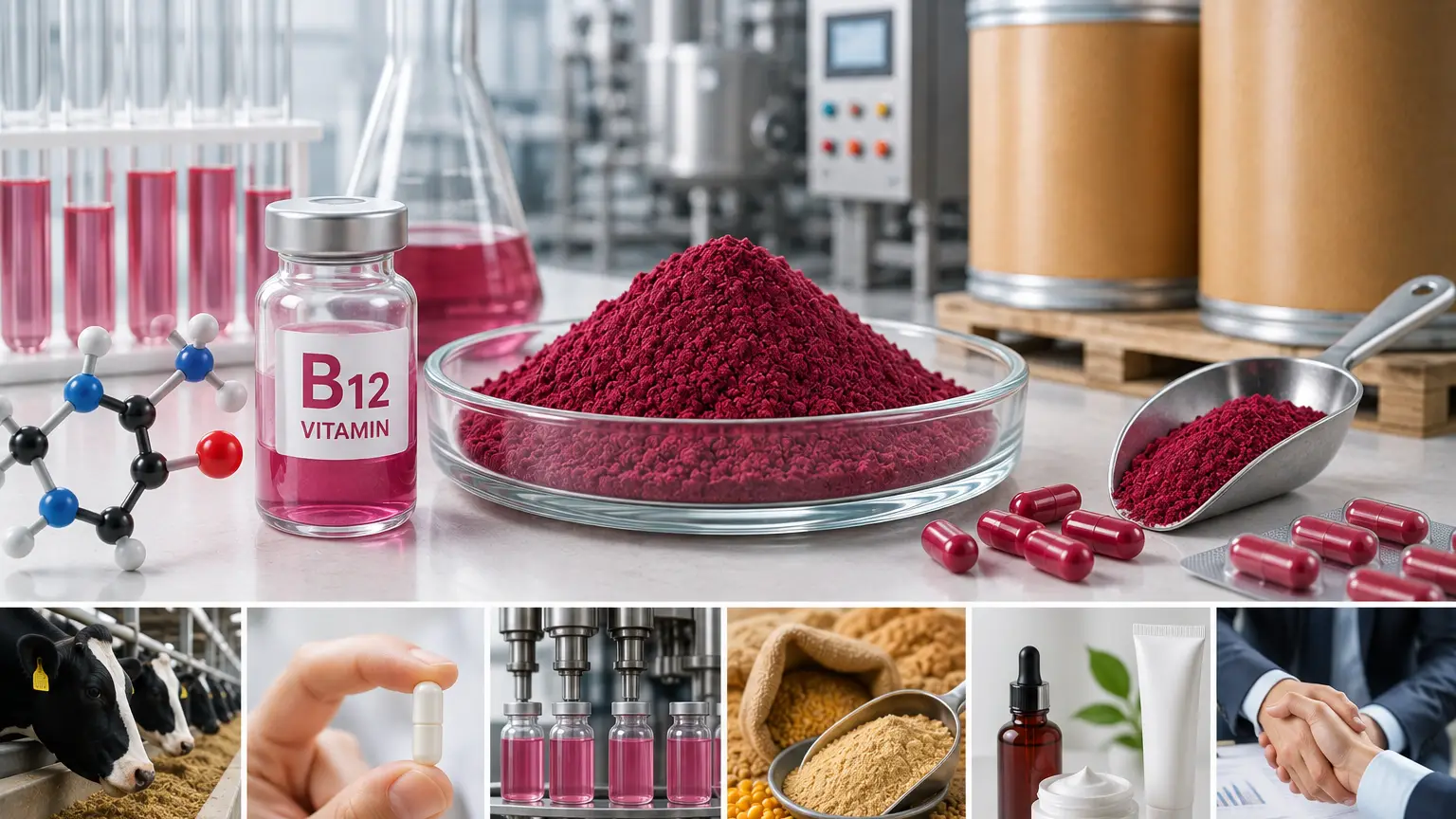
Vitamin B12, also known as cobalamin, is a water-soluble vitamin used across nutritional, feed, pharmaceutical, and food-related applications. The supplied product is identified as cyanocobalamin, a commonly used form of Vitamin B12, with CAS Number 68-19-9 and HS Code 293626. The product information describes it as a dark red to reddish, odorless powder and identifies fermentation as its manufacturing origin. From a procurement perspective, these details establish the material identity and provide a starting point for specification and supplier evaluation.
Vitamin B12 is commercially important because it can be incorporated into products where controlled nutritional supplementation is required. According to the U.S. National Institutes of Health, Vitamin B12 occurs naturally in foods of animal origin, while fortified foods such as breakfast cereals and nutritional yeast can provide additional sources. This makes the ingredient relevant not only to conventional nutrition products but also to formulations designed to deliver Vitamin B12 through fortified food and supplement systems.
The supplied Vitamin B12 specification lists a minimum 1% cyanocobalamin active ingredient assay, moisture below 5%, and a 24-month shelf life. It also lists microbiological parameters including total plate count below 50,000 CFU/g, yeast and mould below 500 CFU/g, negative E. coli per 25 g, coliforms below 100 CFU/g, and negative Salmonella per 25 g. These parameters are commercially significant because procurement teams need to match incoming material specifications with their formulation, quality-control, and regulatory requirements.
For B2B buyers, Vitamin B12 sourcing is therefore more than a simple price comparison. Grade, assay, microbiological quality, certifications, packaging, storage conditions, documentation, and logistics can all influence whether a material is suitable for a particular application. The supplied product is described as feed/pharmaceutical grade, with ISO/HACCP, Halal, and Kosher certifications available, giving procurement teams several criteria to review before progressing toward commercial purchasing.
One of the clearest applications identified for the supplied product is animal feed. The product description specifically states that cyanocobalamin is used as an additive in animal feed to address Vitamin B12 deficiency in animals, while the specification identifies feed/pharmaceutical grade status. This makes feed manufacturers, premix producers, animal-nutrition companies, and ingredient distributors important potential buyer groups for a Vitamin B12 supplier.
Vitamin B12 also has established relevance to pharmaceutical and nutritional formulations. The NIH notes that Vitamin B12 is available in multivitamin and mineral supplements, B-complex supplements, and products containing Vitamin B12 alone, with cyanocobalamin among the commonly used supplemental forms. For pharmaceutical and nutraceutical procurement teams, this creates demand for consistent ingredient identity, assay, quality documentation, and handling conditions appropriate to the intended formulation.
Food fortification represents another important application pathway. Scientific literature describes Vitamin B12 fortification as a strategy for improving nutritional value, particularly because plant foods do not naturally provide Vitamin B12 unless they are fortified. This makes Vitamin B12 relevant to manufacturers developing fortified cereals, nutritional products, plant-based food formulations, and other products where the ingredient is intentionally added during manufacturing.
The end-use application directly influences procurement requirements. A feed manufacturer may prioritize feed authorization, microbiological parameters, batch consistency, and regulatory documentation, while a pharmaceutical buyer may place greater emphasis on applicable grade requirements, analytical documentation, traceability, and controlled storage. Consequently, buyers searching for a Vitamin B12 supplier should define the intended application before comparing quotations or specifications.
A notable application trend is the continued role of Vitamin B12 in fortified foods designed to address nutritional gaps. NIH technical information states that plant foods do not naturally contain Vitamin B12, while fortified cereals and nutritional yeast can provide it. This nutritional characteristic supports the commercial relevance of Vitamin B12 for manufacturers developing fortified plant-based and alternative nutrition products.
Recent scientific research also points toward innovation in Vitamin B12 delivery. A peer-reviewed review published in Molecules discusses microencapsulation, co-microencapsulation, nanoemulsions, nanoparticles, and other technologies intended to improve Vitamin B12 stability, delivery, or bioavailability. For ingredient suppliers and formulation developers, this suggests that future demand may increasingly involve materials compatible with more sophisticated delivery and formulation systems rather than simple commodity supplementation alone.
Scientific literature also continues to examine Vitamin B12 in food applications and different bioavailable forms. A 2024 review indexed by PubMed highlights the vitamin's structural complexity, biological mechanisms, food applications, and relevance to clinical and nutritional research. For B2B markets, these developments reinforce the importance of matching the ingredient specification and form to the technical objective of the final product rather than treating all Vitamin B12 requirements as interchangeable.
These application trends can influence how companies approach Vitamin B12 procurement. Manufacturers may increasingly require technical discussions around dosage systems, formulation compatibility, stability, certifications, and application-specific documentation. Suppliers, meanwhile, can create greater commercial value by clearly communicating specifications and intended-use information, allowing procurement and technical teams to assess whether a particular cyanocobalamin supplier can support their formulation and compliance requirements.
The first stage of Vitamin B12 procurement should be confirmation of material identity and assay. The supplied specification identifies the ingredient as cyanocobalamin with a minimum 1% active ingredient assay and provides CAS Number 68-19-9. Buyers should compare these details against their purchasing specification and determine whether the concentration, form, and grade are appropriate for their application.
Quality control is particularly relevant when Vitamin B12 is purchased for feed, pharmaceutical, or other controlled formulations. The supplied product specification includes limits for total plate count, yeast and mould, coliforms, E. coli, and Salmonella, alongside a statement that heavy metals for feed are compliant. Buyers should use these parameters as part of a broader supplier qualification process and verify the current batch-specific documentation before commercial acceptance.
Physical handling can also affect the practicality of Vitamin B12 bulk sourcing. The supplied product is packaged in 1 kg quantities using aluminum foil bags or brown glass bottles and is specified for storage in a cool, dark, dry environment at 2–8°C while being protected from light. Procurement and logistics teams should consider whether their warehousing, transportation, and inventory procedures can maintain these conditions through the supply chain.
Documentation can become a decisive factor when comparing suppliers. The supplied information identifies Halal and Kosher certifications as available and indicates ISO/HACCP compliance, while technical documents including TDS and MSDS are referenced on the product page. Buyers should request and review the latest relevant documents, certificates, specifications, and regulatory information before qualification, particularly where the ingredient will enter a regulated or export-oriented supply chain.
Typical commercial buyers include animal-feed manufacturers, feed-premix producers, pharmaceutical companies, nutraceutical manufacturers, food and nutrition manufacturers, ingredient distributors, traders, and procurement organizations. The strongest buyer intent generally comes from companies that need Vitamin B12 as an input rather than consumers looking for finished supplements. This distinction makes supplier-focused content particularly relevant to a B2B marketplace environment.
Procurement teams generally need to connect technical specifications with commercial requirements. For Vitamin B12, evaluation can include ingredient identity, assay, grade, microbiological specifications, certifications, packaging format, shelf life, storage requirements, documentation, origin, logistics, and availability. The product information identifies China as the origin and provides a defined specification set, giving buyers a concrete starting point for supplier qualification.
Supplier comparison is important because the lowest quoted price does not necessarily represent the lowest total procurement cost. Differences in specification compliance, documentation, packaging, lead times, minimum order requirements, logistics, quality consistency, and supplier responsiveness can affect the economics and reliability of an ingredient supply chain. For this reason, buyers looking for a cyanocobalamin supplier should compare both technical suitability and commercial execution.
The dedicated Vitamin B12 product page provides procurement-oriented information including origin, CAS number, HS code, physical description, microbiological specifications, assay, packaging, storage, certifications, and grade information. It also provides access to technical documentation and an inquiry pathway for pricing, customization, and shipping, allowing buyers to move from initial product research toward a more specific sourcing discussion.
The animal-feed sector represents a direct commercial application identified for this product. Feed manufacturers and premix companies can require Vitamin B12 as part of nutritional formulations, creating recurring procurement needs where consistency and specification control matter. The product's stated feed/pharmaceutical grade and EU feed additive authorization reference of E880 are particularly relevant considerations for buyers assessing suitability for feed-related applications.
Pharmaceutical and nutraceutical manufacturers represent another buyer group because Vitamin B12 is commercially available as an individual supplement ingredient and as part of B-complex and multivitamin formulations. NIH information identifies cyanocobalamin as a common supplemental form, while the supplied product provides a defined assay and quality specification. These characteristics make specification-led sourcing particularly relevant to manufacturers that need repeatable ingredient inputs.
Food manufacturers can also create demand through fortified products. Scientific reviews identify food fortification as an important Vitamin B12 application and discuss emerging technologies for improving stability and delivery. This creates potential sourcing opportunities for ingredient suppliers serving food manufacturers, especially where product development requires a controlled Vitamin B12 input compatible with the intended formulation and regulatory framework.
Traders and distributors can add value by connecting qualified Vitamin B12 supply with buyers across multiple end-use sectors. Their role may include supplier qualification, documentation coordination, logistics planning, inventory management, and regional market access. In a B2B marketplace context, this supply-chain function can help procurement teams identify suitable sources while reducing the time required to move from product discovery to supplier inquiry.
The most efficient sourcing process begins by defining the end use. Buyers should establish whether the requirement is for animal feed, pharmaceutical manufacturing, nutraceuticals, food fortification, or another permitted application because the intended use can determine the relevant grade, documentation, regulatory requirements, and quality parameters. This application-first approach helps procurement teams avoid comparing technically unsuitable products simply because they share the same generic product name.
Once the application is defined, buyers can compare assay, microbiological limits, packaging, shelf life, storage requirements, certifications, and documentation before evaluating commercial offers. The supplied Vitamin B12 specification provides a practical example of this approach, with defined parameters for assay, microbiology, packaging, storage, and certifications.
Technical documents are important tools for supplier evaluation because they allow purchasing and technical teams to establish whether the material aligns with internal specifications. The product page references a TDS and MSDS, in addition to product-specific quality information. Buyers should request the latest applicable documents and confirm that commercial batches will be supported by appropriate documentation before finalizing procurement.
A B2B marketplace can function as the bridge between technical research and procurement activity. For buyers evaluating Vitamin B12 supplier specifications, the product information can be used to establish an initial technical fit before discussing pricing, quantity, customization, shipping, and other commercial variables. The Vitamin B12 sourcing information can therefore serve as the starting point for a more detailed supplier conversation.
Vitamin B12 is commercially relevant across animal feed, pharmaceutical, nutritional, and food-fortification applications. The supplied cyanocobalamin product illustrates how a Vitamin B12 ingredient can be positioned around defined technical specifications, feed/pharmaceutical grade status, certifications, packaging, storage, and documentation. This combination makes application-specific sourcing more valuable than generic product discovery alone.
For procurement teams, a strong supplier relationship should be based on more than unit price. Consistent specifications, appropriate quality controls, transparent documentation, suitable packaging, reliable logistics, and clear communication all contribute to supply-chain performance. Buyers should therefore assess suppliers against the technical and commercial requirements of their own operation before placing an order.
B2B marketplaces can simplify the early stages of ingredient sourcing by bringing product specifications and supplier inquiry pathways together. For Vitamin B12 buyers, this can help connect technical requirements with commercial discussions around quantity, pricing, shipping, and customization. Tradeasia / Chemtradeasia / Tradechem Marketplace can consequently position Vitamin B12 content as both a market-intelligence resource and a procurement entry point without relying on unsupported market claims.
Companies evaluating Vitamin B12 bulk sourcing, cyanocobalamin for animal feed, pharmaceutical applications, or food-fortification projects should begin by matching the required application with the appropriate specification and documentation. The Vitamin B12 supplier information provides the relevant starting information for reviewing the material and initiating a commercial inquiry, helping procurement teams move from research toward a more structured sourcing decision.
Sources
We're committed to your privacy. Tradeasia uses the information you provide to us to contact you about our relevant content, products, and services. For more information, check out our privacy policy.


 English
 Indonesian
 简体字
简体字
 العربية
 Español
 Français
 Português
 日本語
日本語
 한국어
한국어
 Tiếng Việt



















